36. S.A.M.: The Software Automatic Mouth
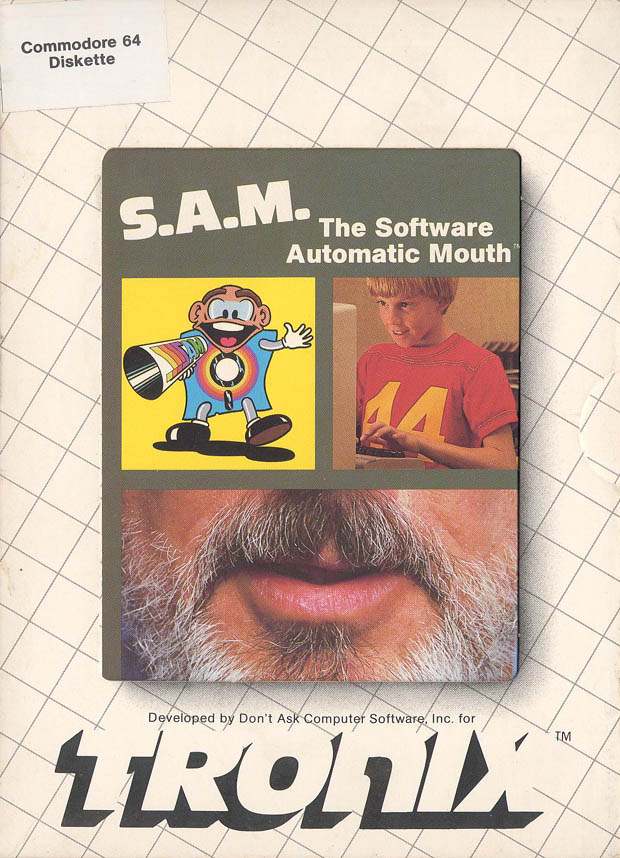
Technology nowadays is moving way too fast for this old Kenosha boy's liking. I've barely got my head wrapped around Eliza, and now I'm hearing about all these space-age AI voice generators that sound like all of my favorite podcasters and politicians? We clearly have warped into hyperspace, and I'm not sure if I'm a comfortable traveler! But hey, somewhere in the distant past of the early 1980s, times were more simple and your speech synthesis utilities were a little more fun, y'know? Let's talk about S.A.M., the Software Automatic Mouth, from Don't Ask Computer Software.
Before we go any further: yes, that mouth on the box is very unsettling.
S.A.M. is one of the first commercial speech synthesis programs and was developed by a programmer named Mark Burton for several computers including the Apple II, Atari, and C64, S.A.M. was first sold as a stand-alone program on disk and cassette, but eventually found its way into other software, such as a poker game developed by Don't Ask, as well as games from other developers that licensed the S.A.M. engine.
The software features two different modes of operation based on whether you prioritize ease of use or accuracy in pronunciation. S.A.M.'s "RECITER" mode prioritizes ease-of-use for users less familiar with the software, allowing more straightforward English-language input (albeit with the occasional phonetic failure - you'll quickly realize it'll have trouble differentiating words like "lead" as in lead-the-way vs. "lead" the chemical element).
If ease-of-use via the RECITER mode isn't a priority, or if you wish to use S.A.M. alongside other BASIC code and save the 6KB of memory that RECITER requires, S.A.M. can allow for more control in pronunciation by relying on a system of 54 different phonemes to reproduce various speech inflections. For instance, entering "KAA4MAHDOHR" nets you a slickly-enunciated "Commodore". This does create some difficulty when a user isn't quite familiar with the system for inflection, as ambiguous commands will be rejected outright rather than being merely mispronounced (with a sharp, disapproving "beep" to chastise you for your failure, no less).
Even using this relatively-superior synthesis paradigm, the quality of speech could best be described as "intelligible", if we're being complementary. The C64 port of S.A.M. relies on the SID chip's 4-bit volume DAC, and its quality doesn't quite reach the heights of the Apple and Atari versions. The C64 also needs to blank the screen during speech, and though there is a way to bypass this behaviour, it further reduces the quality of speech output as a result. (For you technical readers, this occurs as the C64's DMA causes gaps to be inserted into the speech waveform while the CPU waits for the VIC chip to access RAM).
To offset some of these weaker points, there are fine-grain controls that let you tune the pitch, speed, and timbre of S.A.M.'s speech output. The "KNOBS" command allows controls for "THROAT" and "MOUTH" to achieve various effects. Want to sound like an alien? S.A.M. has you covered. Want to sound like a little old lady? Good friggin' luck, but S.A.M. will give it a shot, at least.
Thankfully, S.A.M.'s instruction manual is clear and concise, including a 1500-word dictionary of English-to-S.A.M.-speak, and a few quick references to this list will help you get a hang of S.A.M.'s phonetic system before long. The manual also points to a few of the handy speech utilities to be found on the diskette outside of the standard BASIC "wedge". For example, there's a short demo program that takes you through a showcase of the software's various strengths and features, a basic number-guessing game, as well as a set of notable historical speeches to wow any on-lookers who may wander down into the basement to do their laundry.
Is S.A.M. useful in this day and age? Heck no! It's grungy-sounding and user-unfriendly by modern standards. However, it was quite impressive for its time (especially within the context of resource-constrained personal computers), and I'd bet that more than a few groups of friends and siblings got a kick out of feeding it the fashionable slurs and curse words of the 8-bit era, so What more can you ask for? As far as this guy is concerned, S.A.M. still speaks my language.
This site is copyright 2024 Hank Wesley Chorkin. If you don't like it, you can get out!
Back